
A learning game for kids 5 to 12 · Free until January 4
Know where each kid really is, grade by grade.
A storybook adventure your kids practice in, each at their own level. When they play today, by tonight you'll know where each kid stands, subject by subject. Every Sunday, what to teach next.
- Kindergarten to 8th grade
- Each kid at their own level
- No ads, no store, no strangers
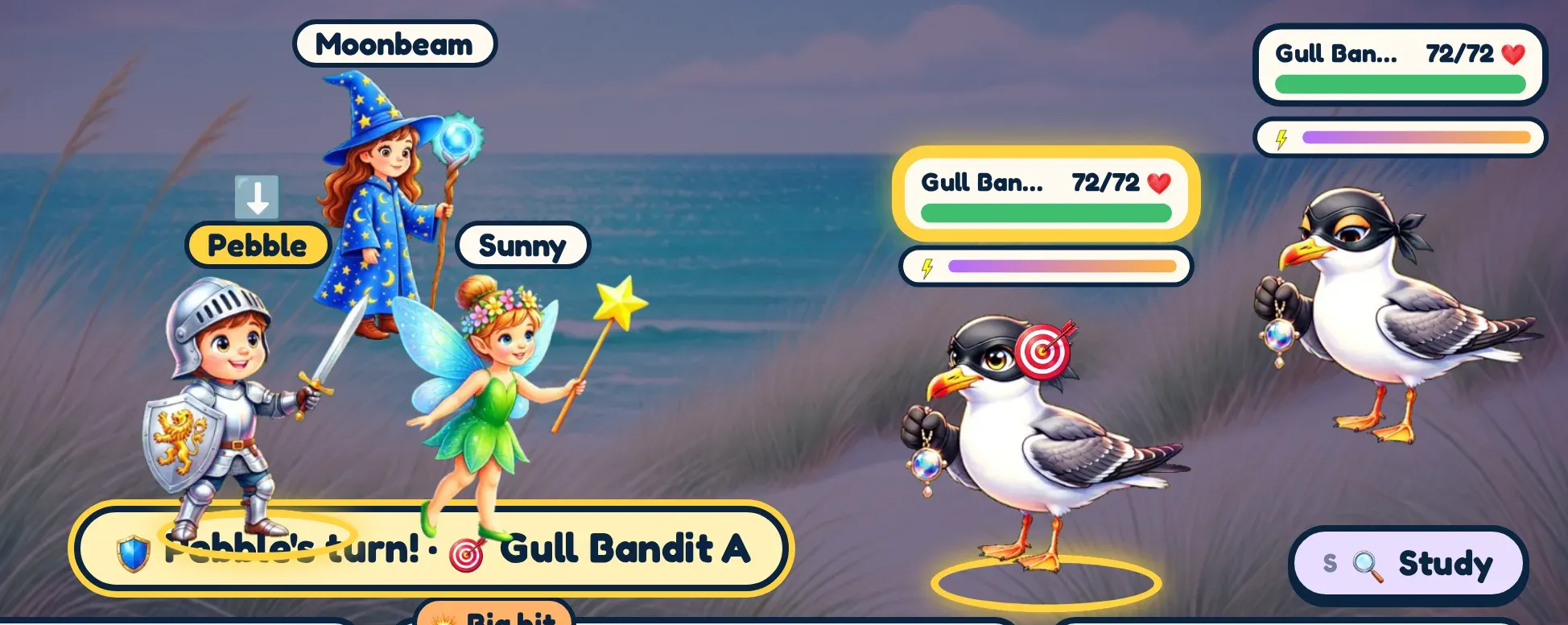
Sound familiar?
If you teach your kids at home, some of these may be yours.
-
“There's no report card. Where is my kid, really?”
You know what you taught. It's harder to know where each kid stands against their grade, subject by subject.
A grade level in every subject
Each subject as a school grade, beside the grade you're teaching.
-
“Three kids, three grades, one kitchen table.”
While you're with the oldest, the youngest needs something real to do.
Every age at once
Each kid has their own level in every subject, even in the same fight.
-
“Keeping records is a second job.”
What did they practice this month? Did reading move? It's on paper, if it's anywhere.
A record that keeps itself
Every answer is kept on the parents' page, by day and by subject. Print each kid's record for any month, term or year, or save it as a PDF. The raw data downloads too.
-
“Is this real learning, or just a game?”
Plenty of apps are games with a few questions sprinkled in. You want to see the questions.
Skills you can read, grade by grade
Math and reading from kindergarten to 8th grade, each grade's skills listed in plain words.
-
“I feel guilty about the screen time.”
If they're on a tablet, you'd rather it asked them to think than played them another video.
Screen time that asks them to think
Nothing to scroll, no ads. You set the hours and the minutes.
Where each kid stands, subject by subject
Set the grade you're teaching, and the parents' page puts each subject beside it: right on track, or how many grades ahead or behind, and which way it's moving.
On their first day, a short riddle game with the Sage gives you a first read, and it sharpens as they play.
See the parents' pageAva's grade: 3rd
- Math About 4th grade About a grade ahead
- Reading About 3rd grade Right on track
- Spelling About 2nd grade Building up to 3rd grade: a grade to go
- Science About 3rd grade Right on track
What Brightkeep does about it
On the parents' page today, shown for a demo family.
-
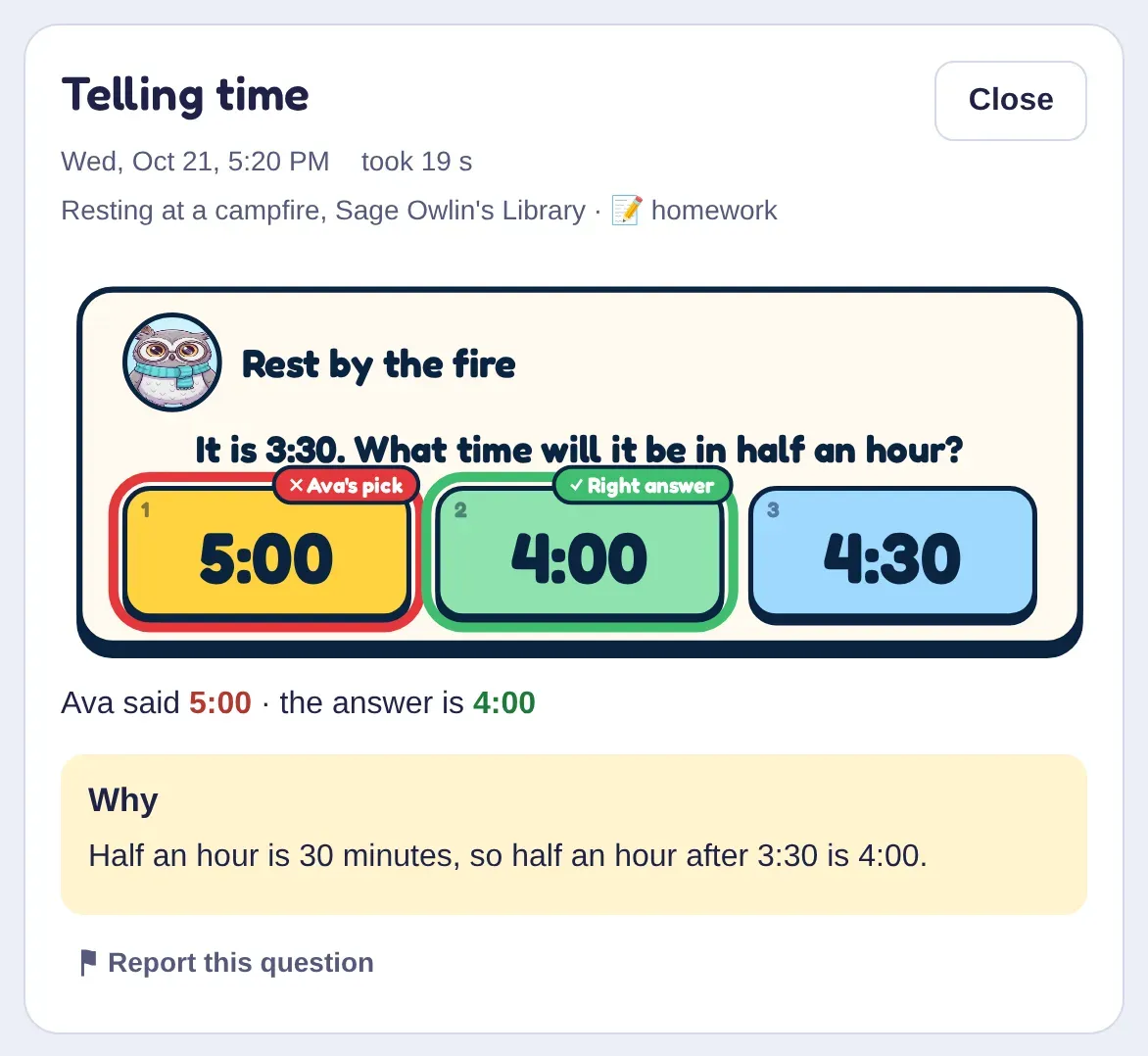
Every answer, and why
Each question with their answer, the right one and the reason, so you see what didn't click and why.
-
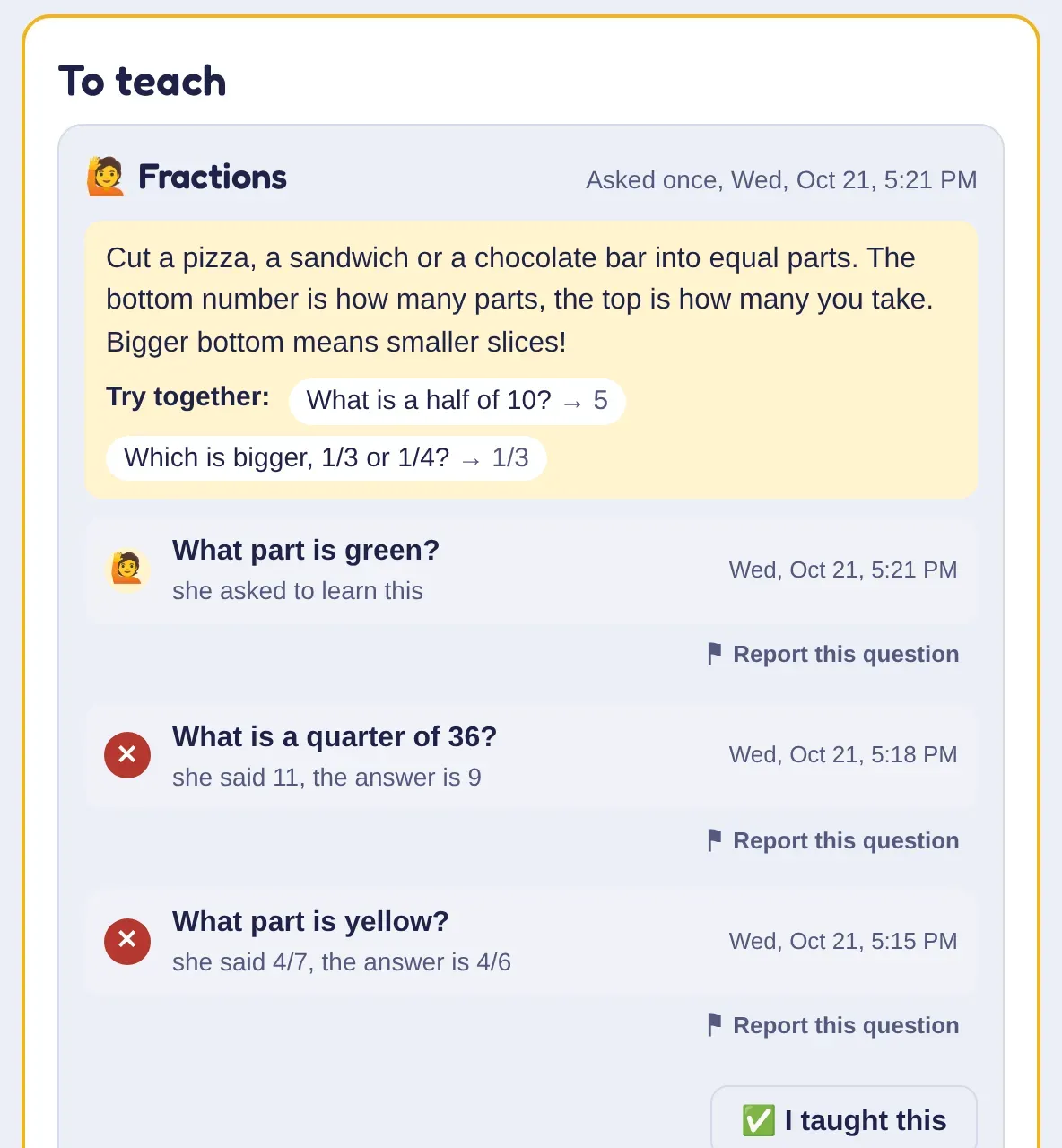
Told what to teach next
Kids can tap “I haven't learned this yet”. It lands on your to-teach list with a tip and a couple of problems to try together.
-
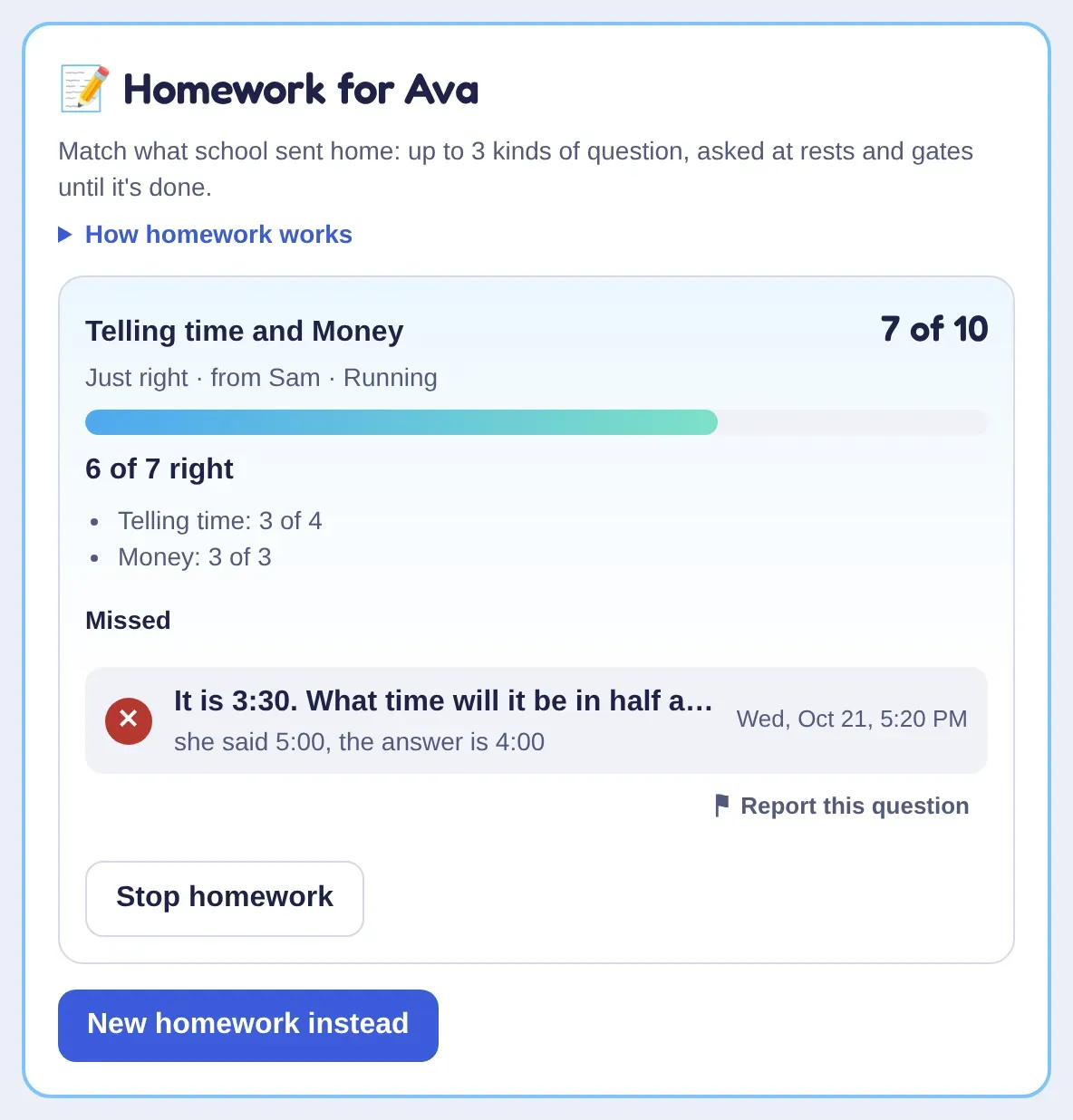
Practice what you're teaching
Set homework from this week's kinds of question, type in a spelling list, or move a subject a grade up or down. The adventure asks those for a while.
-
What they should know
See the skills they should know for their grade, marked solid or to practice, and tap Catch them up to set homework on the gaps. Skills the game hasn't asked yet show as coming up, not as wrong.
-
Skills, not beliefs
It leaves out romance, politics, and religion either way. Once you sign up, you can search every line in the game before your kids play.
What Brightkeep teaches, and what it leaves out
What parents told us
From the first families to play. Most are people we know; we've said how.
-
“The twins have been asking to play after watching [their older brother].”
Jordan F., mom of twins, and a family friend -
“My daughter has been asking me all week to set this up for her.”
Danielle H., mom we met at our daughter's tumbling class -
“We're in. She's running it on her iPad. This is legit!”
Taylor O., dad and fellow software developer -
“That storyline and character setup is flawless.”
Ryan M., dad, and a friend
What Brightkeep isn't
- A curriculum. It's practice: kids answer questions at their level, and you see how it went. It goes beside the books and lessons you already use.
- A transcript or a test. The record you print is a summary of practice for your files or portfolio, not a document for your state. Check your own state's rules.
- A writing program. Kids read and choose; they don't write paragraphs or essays.
Questions you might have
Answered plainly.

Something else on your mind? Jim reads every email. Write to us [email protected]
Is Brightkeep a full homeschool curriculum?
No. It's practice, not lessons: kids answer questions in a game, at their level, and you see every answer. Most families use it beside the books and lessons they already teach. It doesn't teach writing, and a few skills aren't in it yet; the What they learn page lists them.
Is it Common Core?
The questions are organized by grade, skill by skill, from kindergarten to 8th, and the skills list says what each grade practices in plain words. Each math and reading skill also notes the Common Core standard it matches, for families who want that; you don't need to use the standards to use Brightkeep.
Can I use it for my homeschool records?
As your own record, yes. The parents' page keeps every question each kid answered, each subject's level, and their minutes and questions by day. You can print a record for each kid, or save it as a PDF, for a month, a term, a year or any days you pick: time spent, days played, each subject's grade at the start and the end, the skills they practiced and the homework you set. You can also download the raw data. It isn't a transcript or a test, and we don't say it meets any state's requirements: check your own state's rules.
Can I choose what they practice?
Yes. Set homework from the kinds of question you're teaching, type in a spelling list, or move a subject's level a grade up or down. Otherwise each subject finds the right level on its own, climbing when they're ready and easing off when something's hard.
My kids are years apart. Does that work?
Yes. Every kid has their own level in every subject, so siblings play in the same world, even in the same fight, and each gets questions that fit. Questions go from kindergarten through 8th grade.
How much screen time is it?
As much as you decide. Set the hours they can play and the minutes a day on the parents' page, and the game keeps to them. There are no videos to scroll and no ads.
Can I see what my child will see?
Yes. Once you sign up, your parents' page has every line in the game, and you can search it before your child ever plays: what the characters say, the signs, the facts, the spelling words and every kind of question. Type a word, and it shows you where it comes up, if it does at all. Brightkeep teaches skills, not beliefs: it leaves out romance, politics, and religion either way.
What does it cost?
Free until January 4. After that, $49 a year for families who join by November 30, and $129 a year for everyone else. Everything that comes with it is in the offer below.Free until January 4. After that, $129 a year or $14.99 a month; families who joined by November 30 keep $49. Everything that comes with it is in the offer below.
- What's included
- Every subject, land, quest, pet and parent tool, the Sunday email included. Nothing to buy inside the game.
- Kids
- As many as you have during the beta. After it, 2 kids, plus $29 a year for each extra pair, up to 6.
- Paying early
- Optional: pay your first year now from the Plan page, $49 plus tax where it applies. The paid year starts when the beta ends, January 4, so you lose none of it.
Try it with your kids
New families come in a few at a time, with new spots every Monday. When a week is full, leave your email for first dibs on the next.
No card needed. By signing up you agree to our Terms and Privacy Policy.
You're on the list.
We sent a short note to . When the next spots open, you'll get first dibs: one saved for your family for 48 hours.
Join by Cyber Monday, November 30, and you get:Join now, and you get:
$49 a year, locked in
For as long as your plan keeps going. Families who join after November 30 pay $129 a year.
$129 a year, once the beta ends
Or $14.99 a month. Families who joined by November 30 keep $49.
A whole year costs about one hour with a math tutor.A whole year costs about three hours with a math tutor.
A math home tutor: $40–$50 an hour, Thumbtack's national average, as of October 22, 2026. This compares price only: a tutor and a game do different jobs.
-
Your kid's drawing, painted into the world
Each kid can send one. Jim picks the ones that fit and has them painted in, with the credit you choose. See what's in so far
-
A donation equal to your first year
For the first 10 families who pay, to your homeschool co-op, your library, or First Book, which puts books in kids' hands. If you take the 30-day money-back guarantee, there's no donation.
-
Free until January 4, no card
Every kid in the family plays. Nobody is charged unless you choose a plan.
-
Your kid asks to play, or your money back
Email [email protected] within 30 days of your first payment and we'll refund all of it and end the plan. One email is enough.
Joining the waitlist by November 30 counts, even if your invite comes later.Families who joined the waitlist by November 30 keep the founding price, even if their invite comes later.
- Press Start free. A grown-up account with your email. No card, nothing to install.
- Add your kids. A first name and an age each, and they play on a tablet, phone or computer.
- See where they stand. Their first day gives you a read in every subject, and Sunday brings the first email.
 Know a family who plays? They can invite you straight in, even when the week is full.